
It’s the month of March! That can only mean my favorite holiday is just around the corner. I’m a pretty big fan of St. Patrick’s Day and love being able to wear green, pound a few bottles of Guinness, and talk in an unconvincing Irish accent for an entire day.
But lately, I’ve started to feel green as well. I started wearing a little more green ahead of the big day in a few weeks, but decided, after recently noticing my longer boot times on Fedora and what I had been posting last year on this blog, that maybe, just maybe, I could try running openSUSE again. I can’t think of a better time than March!
Why Again?
It seems like it wouldn’t make much sense for me to even bother with this, especially since my last attempt to run openSUSE ended in disappointment. Besides, I was already happy with Arch on my desktop and Fedora on my laptop. Why change a thing?
I’ll be perfectly honest with this: Both The Linux Cast and Chris Titus Tech have gotten me feeling a bit interested in giving it just one more shot this time around. Yes, I’m willing to admit to some level of hypocrisy in my recent blog post about why I don’t distro hop, but perhaps another part of me is still curious over getting everything working in an ideal setup with openSUSE. I mean, it’s something I’ve wanted to have for years, after all. But aside from that, I had also just discovered QuickEmu, as shown in this video from The Linux Experiment:
I know this video is primarily about running macOS, but after seeing how capable it was running other Linux distros, I decided to give openSUSE Tumbleweed another quick spin with QuickEmu. I liked what I saw and felt that it was probably time to give openSUSE one more shot on actual hardware.
This time, there is going to be one major difference. I won’t be using it at all on my desktop this time. My main PC will continue to run Arch, Nobara, and Windows 11 on a triple boot. Instead, I’m going to dual boot openSUSE with my existing Fedora installation on my ThinkPad, so I’ll be sporting two rpm-based distros for the price of one. I’ve already taken the liberty of setting it up with the GNOME desktop today as well, as my attempts to use KDE with openSUSE like last time were a bit of a buggy disaster.
How Did You Set It Up?
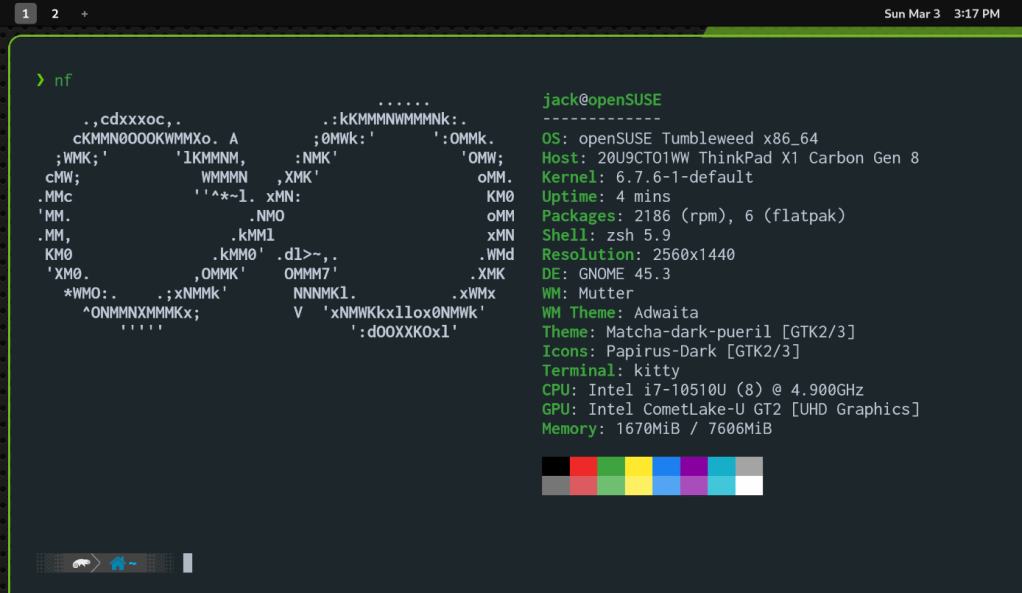
It wasn’t too difficult to make everything installable, thankfully. All I had to do was open GNOME Disks within Fedora, cut off a chunk of space for an openSUSE partition, and then I booted off a USB stick using Ventoy to install everything. I’ve also installed rEFInd from my Fedora partition to make booting both systems a lot less of a colossal pain. Overall, it was a lot less of a headache than when I tried to install it on my desktop. That’s also despite having multiple, separate drives to install it on as well, which you’d think would make the whole endeavor less stressful.
This isn’t the first time I’ve tried to go back and redo something I failed at previously, (see when I tried to switch to a dumbphone for a whole week). Granted, I’m sure this will be much easier overall than switching to a dumbphone, but I am still somewhat curious over how well I can manage and run this system. Besides, should I have any serious enough snags while I’m on the job with this system, I always have my Fedora system to fall back on.
What’s the Criteria?
I’ll define it anyway in case it isn’t so obvious by now:
- I’m going to run openSUSE for 30 days on my ThinkPad workstation for job-related work.
- I’m going to try to use it every work day for my work whenever possible.
- Should I screw anything up, I’ll fall back on Fedora temporarily until I can fix the issue.
- Should I irreversibly mess anything up (not being able to boot into openSUSE at all anymore), I’ll concede and post a follow-up admitting my failure.
- Should I screw anything up, I’ll fall back on Fedora temporarily until I can fix the issue.
- I’m going to be writing on my experience every few days to document how things have gone or any challenges I’ve run into. I’ll compile this writing into one big follow-up blog post scheduled for the future.
- Should I fail this challenge, I’ll post it earlier than scheduled.
I’ll still have a few posts here and there until the follow-up for this, but in the meantime, I’m going green this month for work. Anyway, after an install, I set up the following:
- Getting Brave synced up as I like it.
- Configuring shortcuts in GNOME.
- Changing my GTK theme to Matcha-dark-pueril.
- Getting myself a handful of openSUSE-themed black and green wallpapers.
- Upscaling a few of the older or smaller ones with Upscayl.
- Changing my default shell to zsh and getting Powerline10k set up with a different appearance than my Fedora and Arch systems have.
- Installing Kitty and selecting the “Oceanic Material” theme from the preinstalled themes.
- Installing printer drivers as needed for my job.
- Signed into Obsidian and made the theme feel a lot closer to the aforementioned Matcha-dark-pueril’s color scheme.
- Installing a handful of GNOME extensions to make things feel the way I want.
- Reinstalled spotify-player to enjoy music from my terminal.
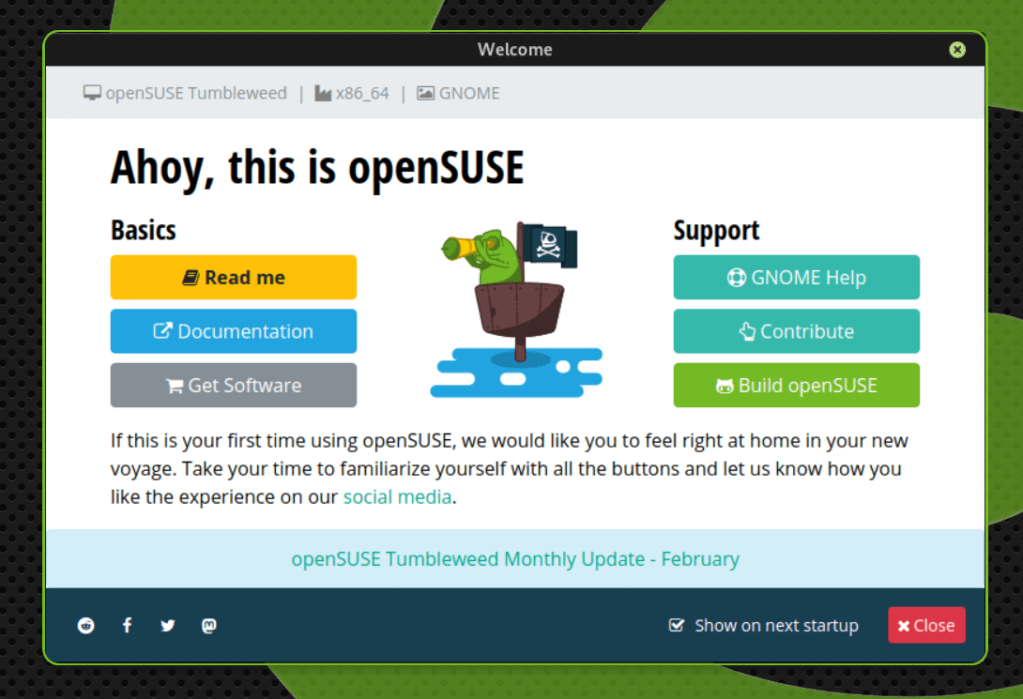
Friendship… Restarted with openSUSE?
While I have the big stuff up and running already, I’m still in the general process of making my install much more comfortable. For instance, I’m going to look into getting my Neovim set up as I like it again very soon. I’ll keep everything posted and see how well or competently everything runs for me from here on out. I am a bit excited, even if I’ve only really copied most of my setup from my Fedora install thus far.
Have you run openSUSE before? How was it? Which default setup or desktop environment did you select? I’d love to know what you think.


One response to “I’m Running openSUSE for 30 Days on my Workstation”
[…] I did dabble in openSUSE Tumbleweed for a long time when my old workplace let me use it as my daily driver, but […]
LikeLike