

This is going to be a much shorter post than I normally do, but I was originally planning a longer, very different post from this.
As regular readers of the site know, I’m a Linux user. At home on my desktop, I run Arch Linux. On the go with my personal workstation, a ThinkPad laptop, I run the latest Fedora.
That in mind, I was noticing something odd over the past few weeks with my Fedora ThinkPad. Sometimes, I would reboot it and it started up as normal. Other times, it ran agonizingly slow, taking almost two minutes to start or reboot.
Time for a Clean Install?
Originally, I conceived the idea of documenting how I reinstalled Fedora on the system and the attempts to get settled back into my setup without all of the extra programs and other unused cruft and dependencies that have built up over the years. After all, I purchased the ThinkPad X1 Carbon Gen 8 with Fedora preinstalled straight from Lenovo all the way back in the spring of 2021.
Additionally, I upgraded through every single version of Fedora released since I first purchased it. Some part of me thought this was just normal, that it was bound to be like this, just like the days in 2008 through 2010, when I would try to upgrade from one Ubuntu release to the next, when I would always have some kind of complication or problem. Back in those days, after all, I was much more prone to distro hopping or doing clean installs.
Speaking of which, maybe it was time to do a clean install and get fast boot times again? Maybe I had installed something that made everything slow without realizing, and I had no idea what it was? Maybe it was just time to have a fresh start again? Maybe it was a good chance to try a different distro?
Still, I couldn’t go through with such a big decision without some attempt at troubleshooting. What could I have been doing wrong?
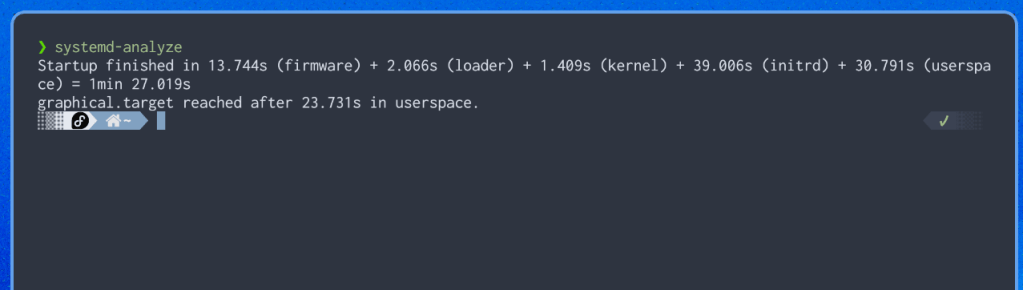
systemd-analyze before I solved the issue. Note the boot time being almost 1 minute and 30 seconds.After searching around for a bit, I finally figured out the issue. As a result, there was no such reinstall of Fedora! I could simply keep running my existing system! Upon typing systemd-analyze in a new terminal window, I figured out my initd was taking the longest by far (though the newer screenshot above makes it look like userspace was equally to blame). That’s when I started to delve down a small rabbit hole that led to such a simple solution.
As it turns out, after entering journalctl -b into a terminal, I was able to find the real culprit behind this: My cheap USB-C hub from Amazon. Booting without the peripheral plugged in led to a relatively much faster startup time of under 30 seconds.
Still, besides the conspicuous fact that I should replace my USB-C hub, it made me realize how different I am compared to the way I was during my first stint with Linux, when I would reinstall at the drop of a hat, when I would jump from one distro to another only to long for the familiarity of Ubuntu sooner or later.
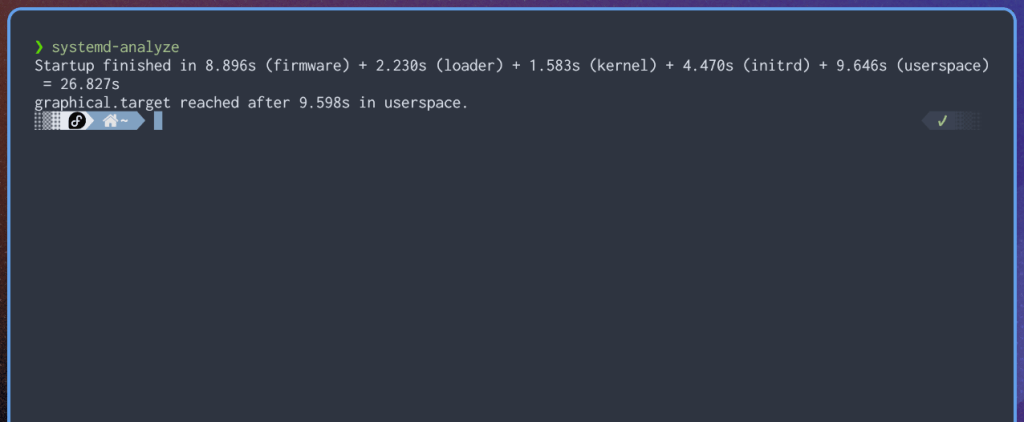
systemd-analyze results AFTER I successfully solved the issue.As I currently am on my second major stint as a Linux user, I’m still using Arch Linux on my desktop and Fedora on my laptop. I have no real desire or plans to switch to another distro. Since I settled into Arch for the first time in 2020, I never saw the grass on the other side looking greener in the slightest. Fedora, upon install, has been so reliable that I don’t feel the need to change much of anything.
But Why?
In short, I have a very different mindset from my first time running Linux. Thankfully, I have grown wiser over the years and see my experience on Linux very differently compared to over a decade ago, when I saw it as a quirky alternative to Windows that needed to be catered more towards my existing mindset.
Now, I know that Linux is something I can tinker and troubleshoot, that I can almost always find a fix for any bug or problem that arises. Back in my Ubuntu days, I fell into the Windows-focused mindset that some problems simply couldn’t be fixed no matter what I did with an existing install (like what would happen if I ran CCleaner too many times), that I would need to clean install and hope it would just go away. But since my time using Linux again, I know there’s always something I can do to fix my system.
The best part is I saved myself a mountain of time I would have otherwise wasted just to have the same issue. The USB-C hub in question is still rather unreliable in its current state, though I do use it regularly for docking into my work setup with multiple displays and connections. However, the hub’s HDMI port became unreliable last year, serving as another clue to how the device was the culprit, which led to myself opting for the HDMI port directly in the laptop as a workaround. However, it seems as if my USB-C hub is causing more issues now with longer boot times, so it would behoove me to find a replacement soon.
Do You Distro Hop?
Thinking about all of this over again made me realize the real reasons why I would originally distro hop. For the longest time, it was always something like the following:
- I don’t know how to solve a specific problem on my distro, so why don’t I try another that probably doesn’t have it?
- I’m kind of bored with or tired of my setup. Why don’t I see what another distro has ready for me out of the box?
- I can’t find something on the repositories or something available only through a PPA is kind of annoying to install or use. I wonder if another distro has it in the default repos?
- Or maybe I can’t find something on the repos and my only option is installing from Github, but I’m not sure how to do it or why I can’t seem to complete it. Maybe another one of these distros lets me get it more easily?
- There’s some other cool little thing I can get, but it’s easier to get it on another distro than mine. Maybe I should switch just to get it for myself?
- Switching to this distro isn’t as nice or as fun as I thought it would be. Maybe I should go back to the one I was already using?
In the end, I would always find myself back on Ubuntu sooner or later after asking myself any of there questions mentally. However, I realize how my current stint has largely solved all of the above issues.
- I don’t know how to solve a specific problem on my distro. I’ll keep trying until I fix it.
- I’m kind of bored with or tired of my setup. Let’s see what themes and customization I can make to my system.
- I can’t find something on the repositories or something available only through a PPA is kind of annoying to install or use. Let me check Github and see alternative means of getting the program on my distro.
- I can’t find something on the repos and my only option is installing from Github, but I’m not sure how to do it or why I can’t seem to complete it. I’ll read the error outputs and see what I need to install or tweak before trying to build again.
- There’s some other cool little thing I can get, but it’s easier to get it on another distro than mine. Let me check into how I can get it on my distro regardless.
- Switching to this distro isn’t as nice or as fun as I thought it would be. What can I do to change that and make it feel more fun?
By looking at everything with this more newfound mindset, I’ve found myself much more settled into my existing distros. While I have had curiosity here and there regarding other distros (I have wanted to try Void Linux, and some notable Linux YouTubers I keep up with have recently switched to openSUSE), I’m still using the same ones and quite contented with the experience.
The most humorous part to me is how my journey back to Linux in 2020 didn’t actually start on Arch but with a brief period of running Kubuntu for the first time in years. When I had been reasonably happy with my setup (wasn’t too crazy about Snaps), I fell in love with running Arch in a VM and decided to make a full install my daily driver. After finding how modular and well-supported Arch was, I stayed on it happily since without realizing it would end my distro hopping right then and there.
Have you distro hopped in the past? What was your time distro hopping like? What distros did you mostly gravitate towards? Otherwise, if you haven’t distro hopped, which distros kept you satisfied? I’d love to hear what you have to say on this.
 Sudo Science
4 responses to “Why I Don’t Distro Hop”
I have several older machines I try things on, but I have stuck with Linux mint for several years. I still play a couple of games on Windows, its just simpler. However most of the last couple of years I’ve mainly used an android phone, for browsing and social media there just to convenient.
LikeLiked by 1 person
Games usually are a lot simpler on Windows, though at this point, I just wish I had more time to play them. I was gifted Baldur’s Gate III for Christmas, and you can only imagine my excitement to see how perfectly and easily it ran on my Arch system. Sadly, I’ve barely played much of it due to how busy I get.
I did like how Linux Mint feels out of the box almost every time I’ve tried it. If I could just past Debian and Ubuntu repos having somewhat older packages, I think I’d feel overwhelmingly satisfied running it as a daily driver.
LikeLiked by 1 person
[…] is tied to why I don’t distro hop, but it’s something that still rings true for me years later. If it works, there’s no […]
LikeLike
[…] I’ve used a bullet journal for several years now. I mean, it’s the very first thing I wrote about on this site. Additionally, I’ve been running Linux as a daily driver even longer than that, running only a few distros like Arch and openSUSE without distro hopping. […]
LikeLike