
I never thought I’d type this, but here we are.
It’s been a fun ride for the past few years, but I saw the writing on the wall a good while back when I felt compelled to restart my second brain in the first place. I really didn’t want to think it was over, and I kept trying to find ways to make it work, especially considering that the first thing I ever wrote on this site was about having the second brain and bullet journal coexist in harmony. But even after setting up Syncthing a month ago on my personal server just to sync my second brain vault, I’m ready to finally admit defeat.
The entire Building A Second Brain (BASB) model no longer works for me.
What Happened?

I came to realize it over time, but everything only culminated recently. I first read Tiago Forte’s BASB book back in the summer of 2022 when it was a new release. Prior to that point, I had been mystified by the idea of having my own second brain app on something like Obsidian, but the thought of trying to use it seemed a bit daunting at the time. Where was I supposed to start?
The book’s timely release gave me a firm, solid direction. Finally, I was finally able to take advantage of this whole new PKM system! Everything could have a place, and I could use my notes and ideas more effectively, and I could even start connecting my notes together! I was going to become more productive and brilliant! The possibilities seemed endless.
Everything was great for the first year and a half. It was only towards the end of 2023 when I began feeling like my second brain became too bloated for its own good. I wanted a clean slate, and I even tried to enhance my second brain by implementing (what I had mistakenly believed at the time was) a Zettelkasten naming scheme. While that did help somewhat, it wasn’t really enough.
I still used my second brain, but only far less often than I once did. However, it took until I got my hands on a book (which I will mention later in this post and likely cover in a future installment of Sudo Science Book Club) that made me seriously stop, think, and reflect on everything I did regarding my note-taking as a whole.
This isn’t an attack on anyone who still abides by BASB or the whole idea of having a second brain. If you are reading this and you are perfectly content with your setup, so be it! That’s perfectly fine. I’m not going to try and persuade anyone to give up a second brain.
Rather, I wrote this to break down the major reasons why I gave up on the idea. I’ll also be writing about these topics assuming readers are at least somewhat familiar with the ideas from Building A Second Brain.
Information Hoarding

PARA and CODE no longer work for me. There, I said it.
Well, okay, credit where credit is due: PARA (Projects, Area, Reference, Archive) mostly works. If I want to know where to put something, more or less, PARA is solid. My only real complaint, I would say, is how I may not know what to put into the first three parts of PARA right away. Should it be under Projects? Area? Reference?
The BASB book does bring up a solution in an “Inbox” folder, but it is downplayed, barely mentioned at all outside of in passing. (Was “PARA” such a catchy acronym that “Inbox” couldn’t work in there? Feel free to correct me if BASB has been updated with this since then.) For the uninitiated, the Inbox is a fifth, temporary “catch-all” folder designed to reduce the friction of adding to a second brain. It’s meant to compliment PARA. That way, I can move along instead of spending time thinking, “Where do I put this?” If I don’t know right away, I can put it in Inbox and decide later where it goes. Other than this shortcoming, PARA is fine.
CODE (Capture, Organize, Distill, Express), on the other hand, is what I have a bigger issue with. I love working with knowledge and notes, but I don’t really need to capture, organize, distill, and express everything I read on the internet with this method. Maybe this works better for others?
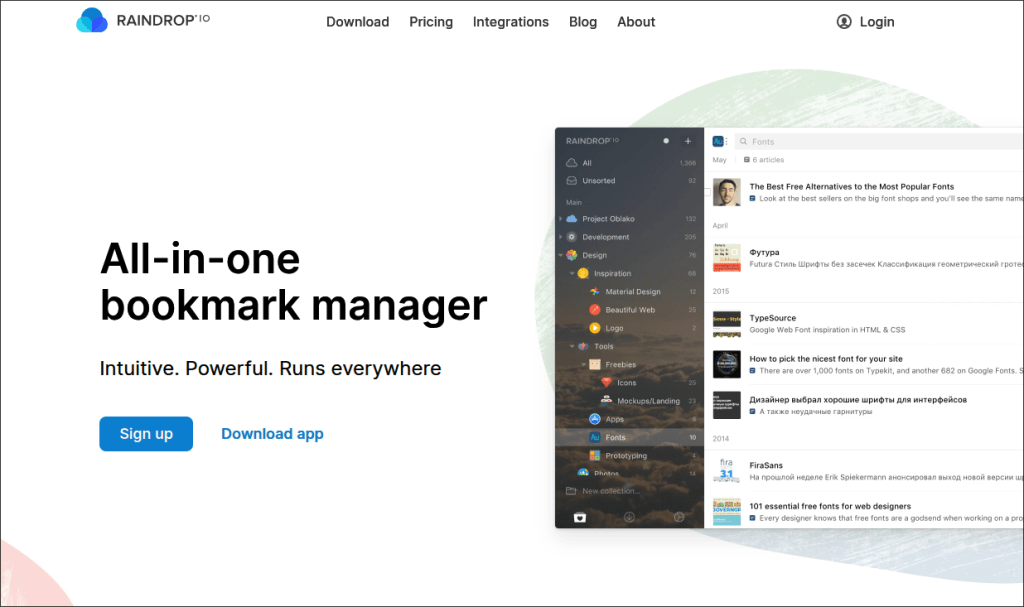
Let me explain: After trying to switch away from Omnivore (when I discovered it was shutting down), I was ready to transition to Raindrop.io as a read-it-later app.
I want to be clear that Raindrop.io is a perfectly competent read-it-later app. In fact, if you really have a need for this sort of app, I would highly suggest considering it as one of your options.
Still, I didn’t really use it for long, and that’s because I simply have no need for a read-it-later app. When I first started using Omnivore and later Raindrop.io, I went on a spree trying to save several articles just to get mileage out of the services, but I never really feel compelled to go back and look at them again after that first day or two. Switching from Raindrop to yet another service wasn’t going to do anything to change that. If I really want to save something to read later, it’s much easier to just bookmark it in Brave and sync it.

The reason I bring this (seemingly unrelated) topic up is because CODE centers around capturing, organizing, distilling, and expressing the things you find online, typically works saved on a read-it-later app. CODE, after all, is one of the big selling points of the BASB model as well. Sadly, for me, this mindset of trying to use a read-it-later app or apply CODE has one of the following outcomes when I try to use it:
- I’ll hoard a lot of articles that I never return to read again.
- I’ll make myself come back to comb through whatever I save and spend a lot of work trying to make highlights and summaries on two or three articles before giving up and not reading my notes again.
Either way, it ultimately feels like a waste of time. While I do like to develop my ideas and thoughts, this isn’t the best way for me to do so. CODE feels designed to encourage continued consumption or the illusion of productivity more than it does actual productivity. Yes, I am aware that the E in CODE stands for “Express,” as in publishing and sharing with others, but even if I manage to capture, organize, and distill information, what am I left with? Even if I gave CODE itself another real chance, it would still feel like a waste of time for my needs.
Drowning In Minutiae
Speaking of wasted time, I found that it’s extremely easy for me to get caught up in a false productivity “trap” when really making use of a second brain. The sad thing is that it feels so intoxicating when I start to feel productive managing little details like this. I still save notes and everything, sure, but then I find myself wasting a lot of time on things that ultimately don’t matter, such as:
- Trying to link my notes together just because I hope that connections are going to make me feel smarter or more productive.
- The appearance of my second brain, such as fonts, headings, and colors.
- Splitting hairs over superfluous things such as tagging systems or custom shortcuts.
- Trying to over-complicate everything with third-party plugins and external workflows on sites like IFTTT.
- Trying to see what kind of fancy bubble map I can make by linking a bunch of notes together.
There’s also the whole idea behind “intermittent packs,” which is supposed to be something you produce with your second brain that you can keep using for other purposes in the future. Now, on paper (or digital text), this makes a lot of sense! Instead of having to repeat specific knowledge-management tasks over and over again, just do a task once, save the research or result as an “intermittent pack,” and bring it back up as a shortcut whenever you do something that requires that workflow again. It’s brilliant in concept.
In practice, however, I only made a small handful of intermittent packs in 2022, and they were mostly left abandoned in my first Obsidian vault because I couldn’t find much to do with them. The closest thing to an intermittent pack that I found useful was simply a template! I have a small handful of templates that let me get started writing within Obsidian, but intermittent packs never stuck with me. I’m sure others have used intermittent packs to great success to save tremendous time and effort, but for my needs, they seem so nebulous.
Overall, while some of these, setups, tasks, and workflows, I admit, can be a little fun, it’s ultimately time I could otherwise spend on actually learning, reading, and taking more meaningful notes. One may be quick to point out that I’m a Linux user, that I “should” already be used to investing time into apps and tinkering. I normally don’t mind this sort of thing, but my priorities are different on note-taking compared to my operating system.
I’ve spent more time than I care to admit on workflows, customization, plugins, tagging systems, metadata, linking my notes, and other things that only convince me that I’m feeling productive. In the end, it’s all an illusion. But speaking of the linking notes, that’s something else I want to talk about.
Linking Notes Is Pointless
This next part is not specific to BASB so much as it is a general trend in PKM apps and digital note-taking. Still, I feel it is worth discussing as well, as there is a good overlap between BASB users and those who practice linking notes.
I know there’s an entire school of thought, popularized by Sönke Ahrens in his book Take Smart Notes, centered around connecting your second brain notes together, forming a gratuitous amount of connections. The appeal comes from “linking your thinking,” and, in concept, this is supposed to encourage second brain users to see things that didn’t connect before, the whole idea of achieving breakthroughs by being able to correlate notes together in new, creative, genius ways.
However, there’s just one problem. The real genius breakthroughs come from “stumbling upon” connections by accident. That spontaneity is what gives us that surprise Ah-HA moment when we connect one unlikely thing with something else. If I’m deliberately linking things together, there’s no surprise; I already saw a link and connected the notes together beforehand. There’s no happy accident, no wonderful serendipity of a genuine, creative breakthrough.
I know I can get around this with a “Random Note” plugin, to increase odds of seeing something randomly and having a thought in my head connect to something recent. For me, however, it’s too easy for me to forget I even have it as a plugin a day or two after installing it.
I mean, I guess seeing a bubble map of linked notes can feel really cool if I have a bunch of them linked together, but what good does it do me in the long run? Is this really helping me grow my mind, my ability to think, my creativity? Is it really making me more productive?
Moving On From Here

Is that it? Am I really giving up on the whole second brain thing? Am I really going to forego taking any notes digitally with tools like Obsidian?
In terms of how BASB markets the idea, yes.
In terms of simply using Obsidian as an app, no, not completely.
In fact, looking at my second brain again, I’ve come to realize that PARA is the only part of BASB that I still find practical. I abandoned the notion of using CODE ages ago, and I don’t have a single intermittent pack anywhere. It was only recently when I reflected and realized the whole system wasn’t worth it for my needs anymore. Maybe it was early on, during the honeymoon phase, but now? Not really.
It’s easy to think this is a bit of a cop-out at first glance, but there is an important takeaway here: I’m going to be delegating less to Obsidian overall. It’s not my second brain. It’s merely a convenient note-taking app now.
See, I find it most beneficial to use Obsidian for “persistent” and practical notes that I want to easily reach between devices. I still plan to store recipes in my Obsidian vault, for example, because it does feel easier than digging up an older bullet journal to find one I saved.
Granted, I’m still in the middle of reflecting on what else I still want to do with Obsidian, so I may delegate more or less (likely less) to the app. At this time, though, it looks like I’m going to predominantly use Obsidian for more static, long-term notes that I want to guarantee quick access to, not anything related to creativity, thinking, or developing knowledge.

That aside, I started a full-on analog Antinet Zettelkasten a few weeks ago to replace the part of my second brain that was in charge of ideas and knowledge. Despite a lot of “experts” touting how much they know about it, I’ve started a Zettelkasten only to discover that most people are completely wrong about what it is or how it works. I even (unknowingly) helped perpetuate misinformation on how a Zettelkasten works in the past.
However, Antinet Zettelkasten by Scott P. Scheper has opened my eyes on how exactly a fully-analog Antinet Zettelkasten is supposed to work. He cites the actual work of Niklas Luhmann, the late researcher who used this analog system extensively. It turns out so many people on the web have a fundamental misunderstanding of how a Zettelkasten is supposed to work, but this book so far has cleared up all of my confusion. Keep in mind that I would normally be confused on what a Zettelkasten was after searching online a few years ago on how to start one; results were always nebulous or all over the place.
The book has, additionally, given me great insights on the advantages of going analog when it comes to writing down what I learn by hand. Plus, it has already fixed the numerous issues I’ve had with my second brain, but I’ll go into that in further detail in a future post. Also, full disclosure: I know it sounds like I’m seriously promoting Scheper’s book, but I bought it with my own money and was not paid or persuaded by anyone to say anything other than my honest thoughts on everything. I will, however, admit that it took me about 120 pages in when I started to question the point of my second brain as a whole.
From there, I sat down to seriously reflect on how I really wanted to use a second brain, soon deciding that I don’t really need it anymore according to BASB principles. While I’ll continue to at least use PARA, my Obsidian vault’s setup has significantly dwindled in terms of my overall use and attention. It’s a far cry from 2022, when I had dumped almost everything into a second brain in the first place. That’s why I’m cleaning house in my current setup to make it something much more practical, greatly simplifying everything.
Until then, do you have a second brain yourself? Have you been getting a lot of use from it like you hoped? If not, what isn’t working? Are you still perfectly happy with your second brain, or has this made you think over how exactly you use your own? Did you think I was “doing it wrong” when it came to using CODE or intermittent packs? Feel free to drop a comment below. I would love to know what you think of this fascinating subject.
 Sudo Science
2 responses to “Why I’m Giving Up on a Second Brain”
[…] former second brain, now demoted to a simpler and more streamlined Obsidian […]
LikeLike
[…] surely been a while, as 2026 is now approaching. Quite a bit of time has passed since I stopped using the whole BASB “Second Brain” system as conceived by Tiago Forte, almost two months to be more […]
LikeLike