

I started seriously using Spotify approximately nine years ago. My current account is the one I’ve stuck with through thick and thin, and it has so much of my listening history from over the years.
But I’d be lying if I said the grass didn’t look greener sometimes. I believe it was almost two years ago now that I tried to eschew Spotify in favor of my local collection of MP3 music. While that did offer some advantages, it was also largely inconvenient, and the straw that broke the camel’s back was how much I missed my Spotify Wrapped. I know it’s not the best excuse, but that did lead to my eventual return to Spotify after avoiding it for approximately five months in 2022, and I have been using it ever since.
Still, I was reading an article my girlfriend sent me about 81 things that “we should never buy.” I refuse to link to it, as it follows the atrocious trend of putting multiple items on a list into a slideshow format, a means of reading articles that no sane person likes. However, there were a few items on the list that made me think twice, some that made me disagree, and one in particular that I strongly disagreed with:
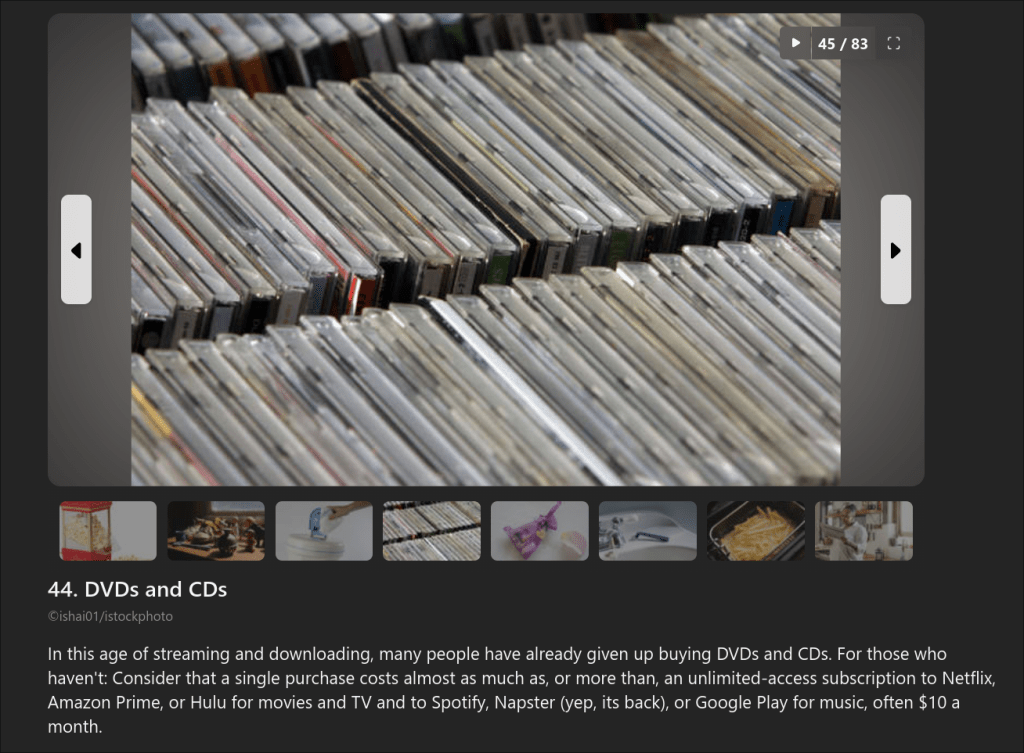
If anything, the proliferation of streaming services is a perfect reason to actually buy DVDs again. What could be more annoying than wanting to watch that one show only to discover you can’t? It always boils down to the same handful of reasons:
- The show was on one of the services you’re subscribed to, but it’s gone now! You waited X number of days too long and now you’ll have to subscribe to another service or just not watch it.
- It’s there, but only a few seasons are available due to licensing agreements. The other seasons are on another service you don’t have.
- Licensing agreements or other issues cause one or two episodes to be missing altogether. One episode could be gone entirely because there was licensed music in it. Another could be gone because some trivial and potentially controversial thing offended the wrong person, and now nobody gets to see it ever again outside of an old DVD release.
- The aspect ratio is messed up and the service still hasn’t fixed it, which leads to a few ruined moments (yes, I am still thinking about how The Simpsons looks on Disney+).
- The show you wanted to watch keeps getting moved around. First, Netflix had exclusive rights to it, then Prime Video did, and then Hulu, and so on…
Ultimately, it’s so much easier and less of a headache to just buy a DVD box set of a show you know you’ll want to go back to over and over again.
But that’s all beside the point. The real point is I noticed the text reading how Napster was back. If that was true, then that means Napster is back now in its third incarnation. Curious to see how Napster rebranded from the first mainstream P2P sharing service 20 years ago to an iTunes wannabe in the late aughts to a possible Spotify competitor in the present, I read into the service on their home page.
They offered a 30-day trial, a large number of tracks, lossless audio quality, and the ability to transfer from other streaming services. Since it was just a 30-day trial, I decided to throw caution to the wind and sign up. How would this fare compared to my usual choice of Spotify, especially from the perspective of a Linux user?
While I was at it, I decided to go a few steps further. Why stop at just Napster? I could take a look at a few other Spotify alternatives (other than Apple Music for obvious reasons) and see how they stack up in terms of usability on Linux as of the time I post this.
Additionally, before anybody points it out, yes I am also aware of the irony that I criticized video streaming services while turning this whole post into a three-way comparison between music streaming services, but I thought that maybe it was time to see if leaving Spotify was going to be worth it this time like when I last attempted to a couple of years ago. There is also an elephant in the room regarding this whole idea (it may be in the form of a question you may be thinking about), but I’ll discuss that in a bit more depth in the conclusion of this blog post.
The Criteria
If I’m going to at make some fair attempt to evaluate the services by comparing them to one another, we’re going to need some ground rules. As such, I picked the following categories to rate for each music service on a scale of 1 through 3, with 1 being the lowest and 3 the highest. Explanations will be included with each criterion on this list.
- Music Selection: The most subjective category here, but how many of the songs that I wanted was I able to easily find from Spotify? With a music collection as large as mine (a few dozen playlists with over 6,500+ songs), some tracks will be missing.
- Score of 1: Couldn’t find most of the songs I wanted. Some songs or entire albums are missing with no rhyme or reason.
- Score of 2: A chunk of music is missing from my collection, but most of the important stuff is available to listen to.
- Score of 3: Nearly everything is available. Only missing songs are just about what I expected to be missing, but migrating to this service permanently wouldn’t be hard.
- Other Features: Does the app include other features, or does it only play music?
- Score of 1: App only plays music, although this isn’t always a bad thing.
- Score of 2: App plays music and supports other music-centric features like casting to other devices, sharing playlists, and so on.
- Score of 3: App supports many music-centric features and additional features such as podcast playback.
- Android App Support: How good is the Android app? Does it function well and let me listen to music at a good audio quality with minimal issues?
- Score of 1: App is unstable or gives me issues on at least one occasion. The desktop app may be much more usable.
- Score of 2: Trying to get a few things done with the app can be a pain or impossible at least once or twice.
- Score of 3: App functions perfectly with zero compromises. No complaints at all.
- Linux Support: The most important category for me, but how easily can I access and stream music from the service on a Linux system?
- Score of 1: App has no Linux support; I’m stuck using the web UI with compromises.
- Score of 2: App has unofficial Linux support from a passionate user, but the app amounts to an electron app at best.
- Score of 3: App has either official Linux support or an unofficial app with more effort than expected put into it.
However, I will not be granting ratings for the following criteria:
- UI and Usability: When comparing all of these services side-by-side on an aesthetic and usability perspective, they are all more than comparable to Spotify. There wouldn’t be a whole lot to say. Instead, if the particular app or apps have something nice or annoying, I’ll just bring them up separately without giving them ratings, as the apps typically offer something unique to stand out from the competition.
- Detailed Audio Quality: It goes without saying that just about any alternative can boast superior audio quality to Spotify execpt for perhaps maybe YouTube Music. However, as somebody who has used YouTube Music in the past, I won’t even bother. Comparing YouTube’s music streaming offering to any of these services is like comparing a slingshot to a machine gun.
- Recommendation Quality: I don’t think anything is going to top Spotify in this realm. Most services only use one algorithm to recommend more music you may like, but Spotify has three that get cross-referenced together, which makes their recommendations system so appealing and personalized. It’s much-appreciated if you want some genuine recommendations instead of being recommended the same handful of somewhat mainstream songs that get the highest play counts.
- Migration Difficulty: I was originally going to rate this until I discovered a service that let me transfer my Spotify collection to all three of the services I’m looking at. As such, the difficulty of moving all the music from the other services was the exact same series of steps. While I don’t like that I had to pay, I feel like it was worth the one-time cost to fairly evaluate the services on “Music Selection,” as I could easily compare the amount of tracks that were not imported successfully. Still, I didn’t actually save the numbers of songs that imported successfully, but I have a general recollection of how many transferred.
That said, let’s start off with Napster, the service that inspired me to give this whole endeavor a shot in the first place.
Napster
- Music Selection: 2/3
- Other Features: 1/3
- Android App Support: 3/3
- Linux Support: 1/3
- TOTAL: 7/12
- Surprising Advantages: Android app functions remarkably well.
- Unexpected Disadvantages: Highest-fidelity audio doesn’t work with the browser player, Linux support is non-existent.
I had originally written quite a bit about this in a previous draft, but when I decided to branch out and try more services, I had to go back and reevaluate Napster from square one to make the comparison more fair.
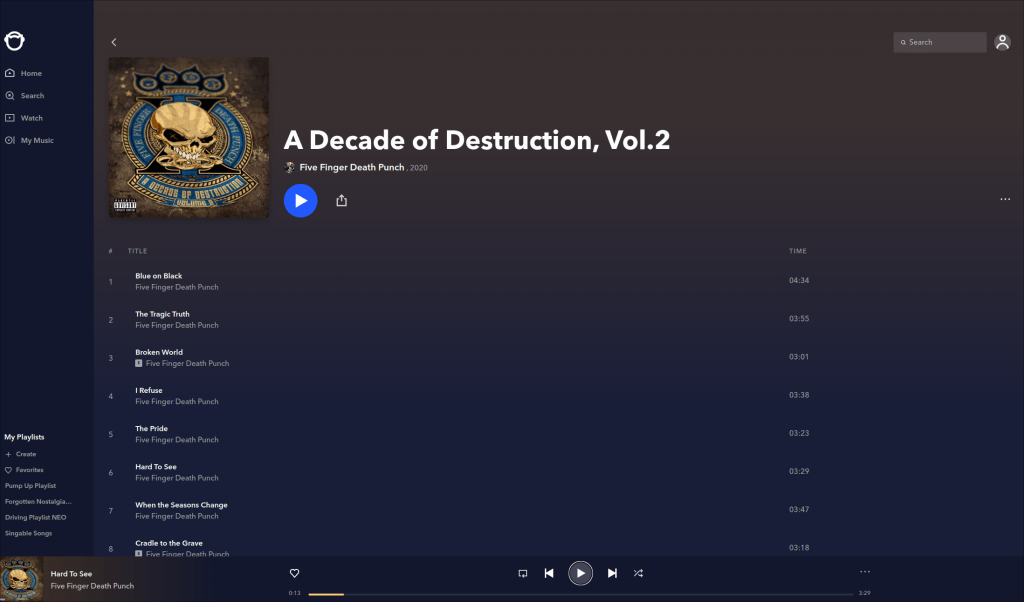
Additionally, I’ll be the first to admit that I dropped use of Napster after less than a week into my free one-month trial. But before I delve into that, I did want to discuss how much I liked the audio quality overall. Right out of the gate, I always found the sound fuller-feeling and more satisfying to listen to.
Of course, I would like to talk more about the music selection, but for my particular purposes, I was forced to cancel my subscription before the trial ended because I was extremely unhappy with a few surprises. If these hadn’t been an issue for me, then I would have used Napster for much longer than I actually did. But for now, let me start with my first big deal-breaker.
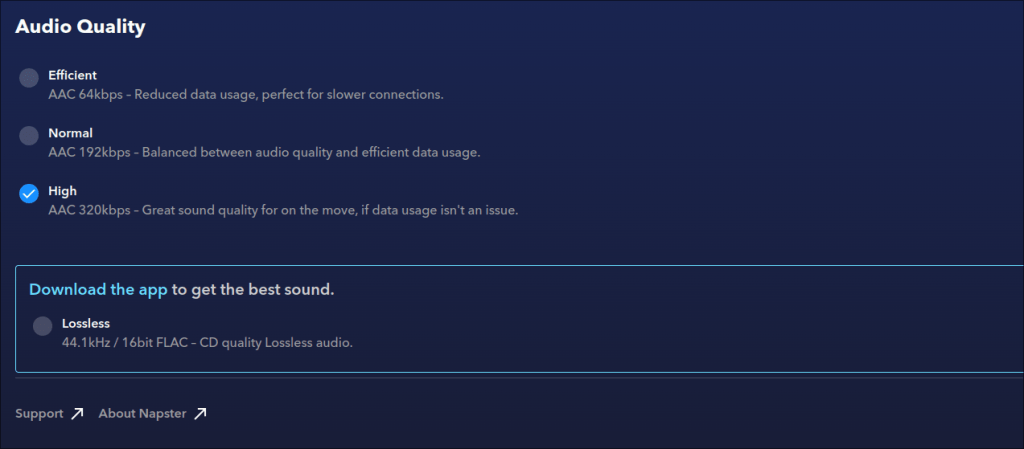
The highest quality audio is only available on the app. If you’re using the web player, you need to install the app and listen through there for the best possible experience. For a few days, when I was driving with the Napster app on my phone, this was no big deal. I got the sound quality I wanted and everything was fine.
Unfortunately, this was inexcusable on Linux. There’s no app support here. In fact, there isn’t even so much as an unofficial desktop app to take advantage of the sound quality. Well, there is one available as a Flatpak, but it has two major disadvantages when I try running it on my openSUSE device:
- The UI was designed with Steam Deck users first and foremost. As a result, it feels awkward to use it on a PC with a keyboard and mouse.
- I can’t get this thing to play any audio to save my life. Maybe it works on Arch, but I do most of my music listening at work from my openSUSE workstation.
As a result, I don’t have a whole lot to say on this one. I did notice some missing songs here and there, but not enough to actually compare for much longer than a week. I suppose if I had been a regular Windows or macOS user that I would have continued using the service, as those platforms do have official support. However, the lack of Linux support was too much. I didn’t continue to use Napster for long and found myself canceling before I knew it.
TIDAL
- Music Selection: 2/3
- Other Features: 2/3
- Android App Support: 3/3
- Linux Support: 3/3
- TOTAL: 10/12
- Surprising Advantages: Apps have so many remarkable quality of life features I would love to see on Spotify; has more music than I expected.
- Unexpected Disadvantages: Streaming from some places without a wifi connection is remarkably slow; some random albums are missing with no rhyme or reason.
At the time I’m writing this, I have had a wonderful time using TIDAL so far despite a few hiccups here and there, which I will elaborate on. For starters, the music selection feels about the same, if not, slightly better than Napster’s offerings. Whatever more niche albums I didn’t find on Napster that I would easily find on Spotify were typically available on TIDAL.
However, when I did notice missing music, it was perplexing. While I wasn’t originally planning to discuss my musical taste (feel free to tell me how great or terrible my taste is in the comments; I don’t mind), I wanted to listen to Omnium Gatherum when test driving TIDAL, but I noticed New World Shadows, their 2011 album, was completely missing despite the presence of the rest of their discography.
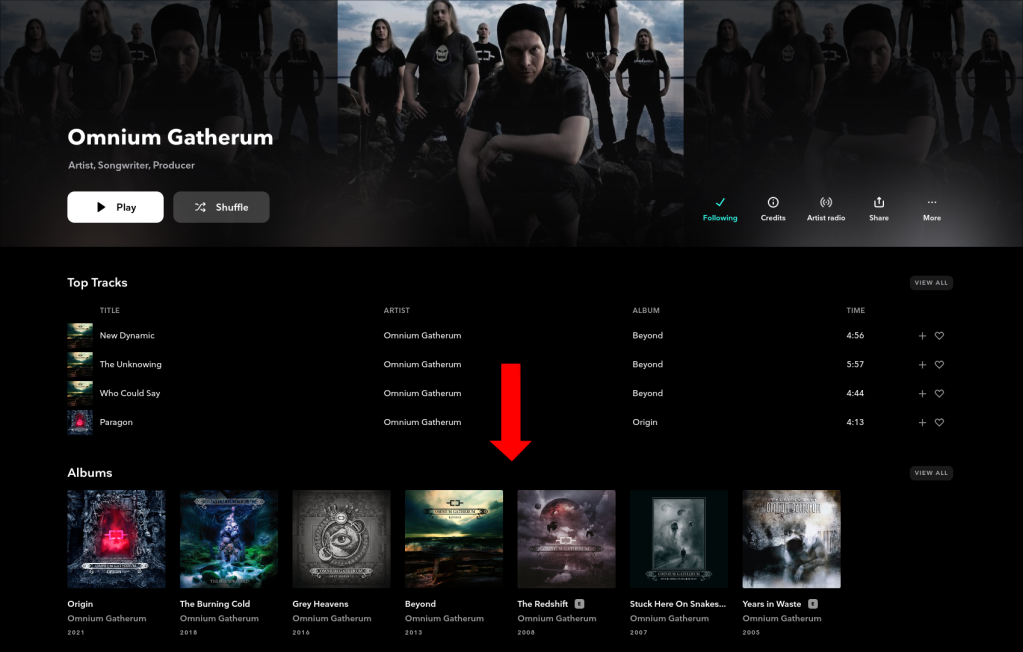
This one hurt because it was my first album I ever heard from the group. While this would have been weird if this were the only time it happened, I have another example: I felt like listening to Raunchy, a band from Denmark, and I discovered their 2008 album, Wasteland Discotheque, was entirely MIA too.
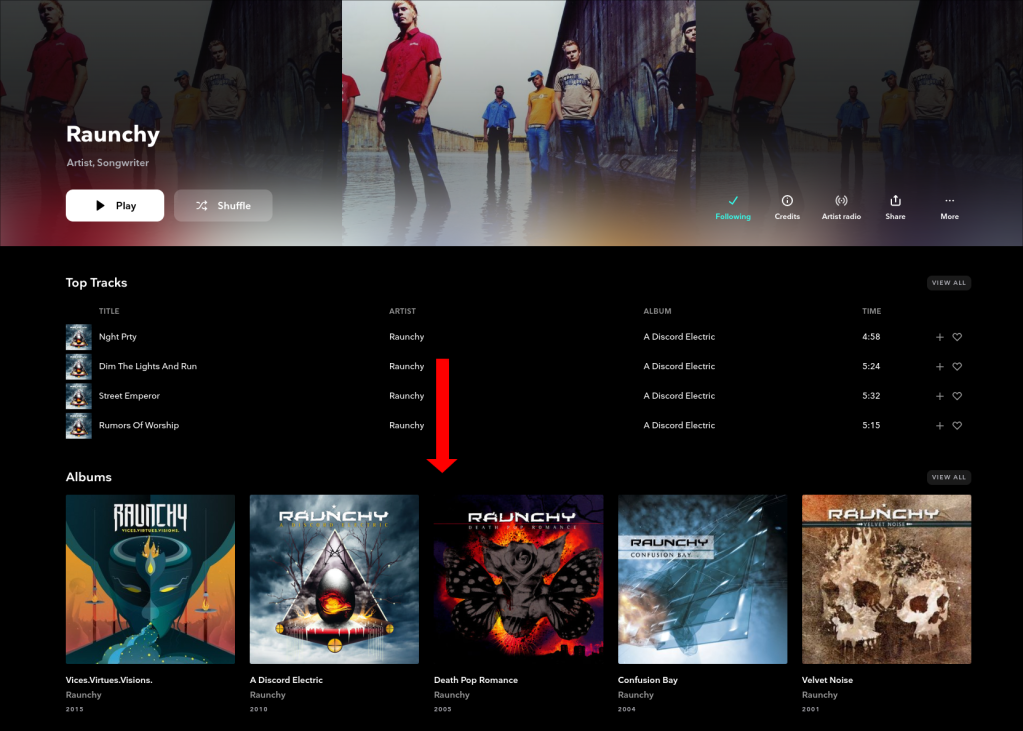
This one also hurt, as I associate their 2008 album with my senior year of high school. Still, while I’ve had a better overall experience with TIDAL than expected, this sort of thing with missing albums only takes me back to why I even started writing this blog post in the first place, how streaming services can easily take away what we can access because of licensing and other annoyances. (Yes, I am still aware of an obvious question some readers might have, and I haven’t forgotten how I will address it at the end of this post.)
On the bright side, listening with the unofficial TIDAL Hi-Fi app on Linux has been above average. The creator of this electron-based wrapper app went above and beyond with support for CSS themes (although I believe it’s not enabled at this time), various UI tweaks, and keyboard shortcut support that I wouldn’t expect to see in an official app.
Despite everything, the app is so well-made and solid from the get-go, unlike Napster, that I can’t complain in the slightest.
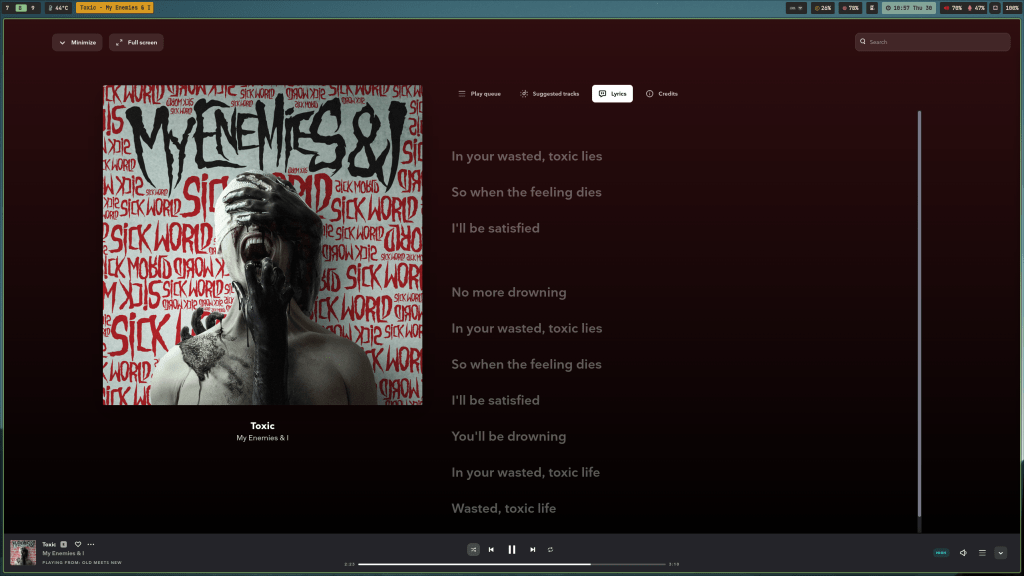
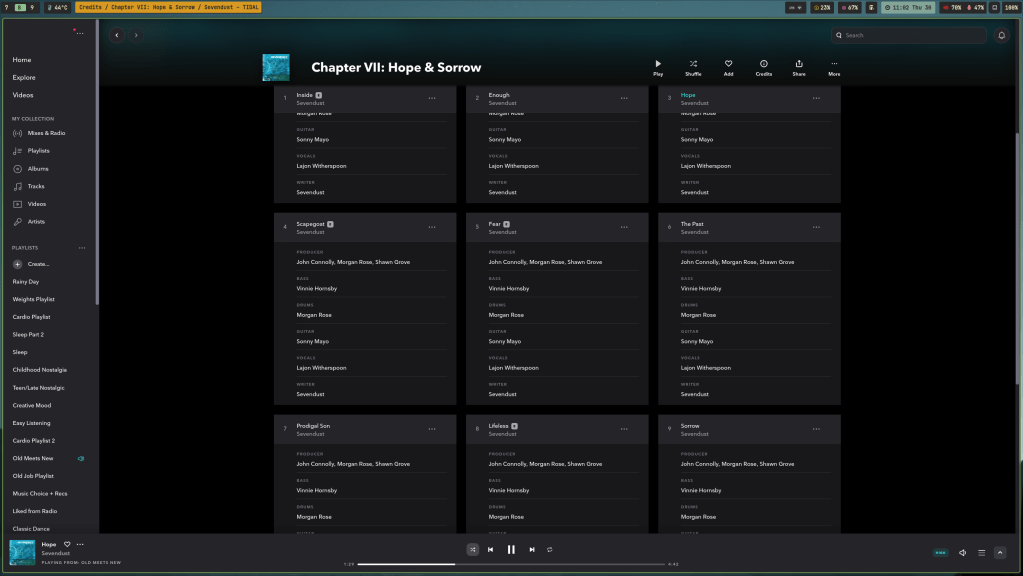
I love all of the little tweaks and options that the unofficial Linux app offers for TIDAL, and that’s despite the absence of a working CLI interface for Linux, whereas Spotify has at least two that I know of right now.
But speaking of tweaks, I can’t completely say the same about their official Android offering. While it doesn’t have many tweaks or crazy features, I’m glad to report the stock Android app is much nicer and far more pleasant than I ever expected it to be!
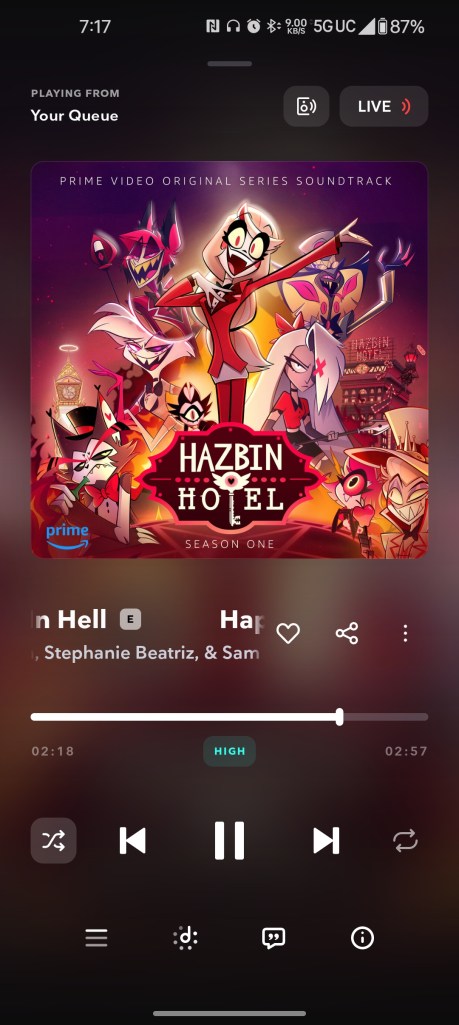
I’m even going to state it right here: I originally planned to finish writing all of this much sooner, but I found myself growing so comfortable with TIDAL as a whole that I simply wanted to keep using it instead of giving Deezer a real go.
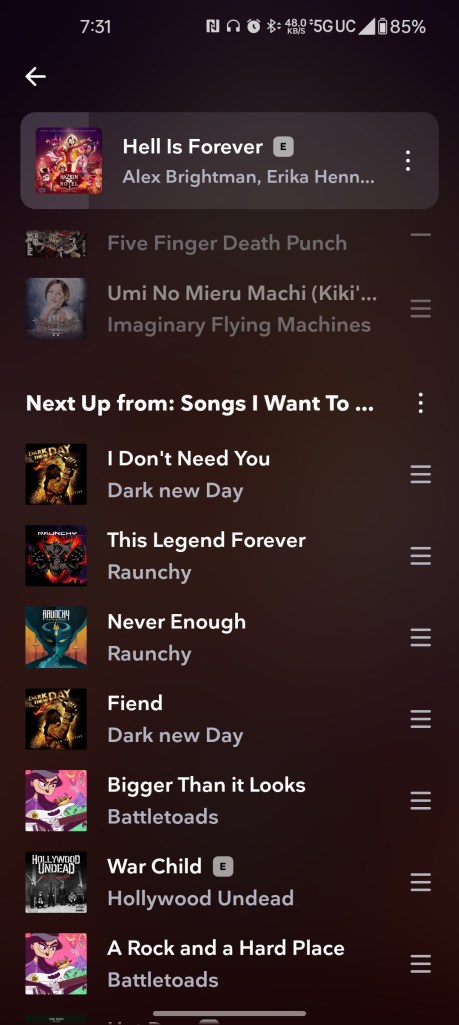
This Android app has so much polish in places I don’t expect to see it with small quality of life improvements and decisions. For one, I love the brushed acryllic look, and it’s nice to see it on something that isn’t Deepin Desktop or completely evil like Windows 11. Additionally, there are so many little thoughtful tweaks and improvements here and there. For example, if you look at the queue screen, you can see a horizontal bar over the playing track. It fills up as the song plays, giving you an indication just how far along the song is as you scroll through the rest of your queue.
Still, the only hiccups I’ve had with the app are how streaming the highest possible quality audio can be slow at times without a wifi connection, although I think that’s more an issue with my carrier than the service itself. I don’t notice it on my drives to work and back, but I noticed how long songs took to buffer and play when I was working out at my local gym. I had to resort to downloading a few large playlists from home to make sure this didn’t happen again.
One of the bigger advantages, in my eyes at least, deals with how TIDAL handles where you left off. I know one of the biggest draws to Spotify is being able to pick up on the playlist you were on where you left off on another device (e.g., you play music on your desktop, walk out, and continue playing it on your phone). TIDAL didn’t really do this, but I actually see this as more of an advantage. Whenever I’m working at the desk or just around the house, I prefer different playlists from when I workout or drive somewhere. As a result, I can go back to where those separate devices left off independently from one another. I don’t have to deal with starting a shuffle again and re-listening to a recent song too soon, which usually means I’m tempted to skip a track.
To make things better, on a day when I was thinking about how much I liked using TIDAL and the handful of disadvantages it offered, this popped up in my inbox:
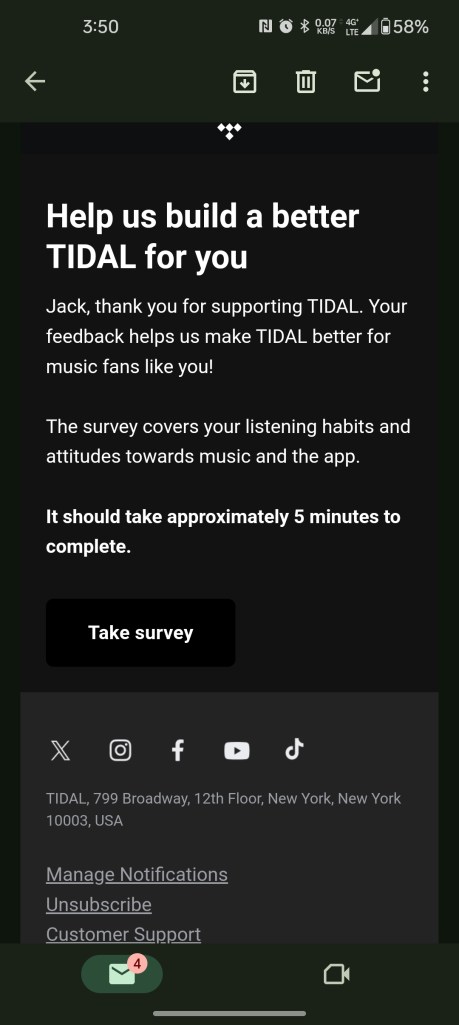
Let’s see what results from this in the future. Overall, despite some missing music, a lack of podcast support, and the absence of a CLI app on Linux, I’ve been unexpectedly much happier with TIDAL than I ever expected to be.
UPDATE: Future me updating with something else I finally noticed. After looking closer into the TIDAL app on Linux, I found a section that contained podcasts. It was pretty out of the way and a little hard to notice, but they are there. Unfortunately, the selection is pathetically small with just 13 podcasts upon clicking “View All,” so I won’t actually count this as real podcast support. While podcasts are technically available here, it’s slim pickings and an utter far cry from Spotify’s offerings.
UPDATE AGAIN: After being asked about it, I was prompted to look into TIDAL’s podcast selection. However, the podcast menu I had mentioned has since gone entirely missing. It’s possible that TIDAL quietly removed it from the app since then. I searched through both the Android and Linux apps, but found no trace that podcasts were ever so much as offered in the first place.
Deezer
- Music Selection: 3/3
- Other Features: 3/3
- Android App Support: 2/3
- Linux Support: 2/3
- TOTAL: 10/12
- Surprising Advantage: Best song parity I’ve seen compared to Spotify’s offerings, supports podcast playback like Spotify.
- Unexpected Disadvantages: UI feels a little confusing on Android, some header fonts look a little off-putting.
Deezer would otherwise come off as a serious winner. It has the most on-par music selection I’ve noticed compared to Spotify, as TuneMyMusic had the fewest songs missed when I moved my playlist. Even then, it only missed a handful of songs I knew wouldn’t actually transfer over (e.g., music I originally added to old Spotify playlists back when I ran Windows and transferred MP3s of hard-to-find tracks over to synchronize and download to my Android phone).
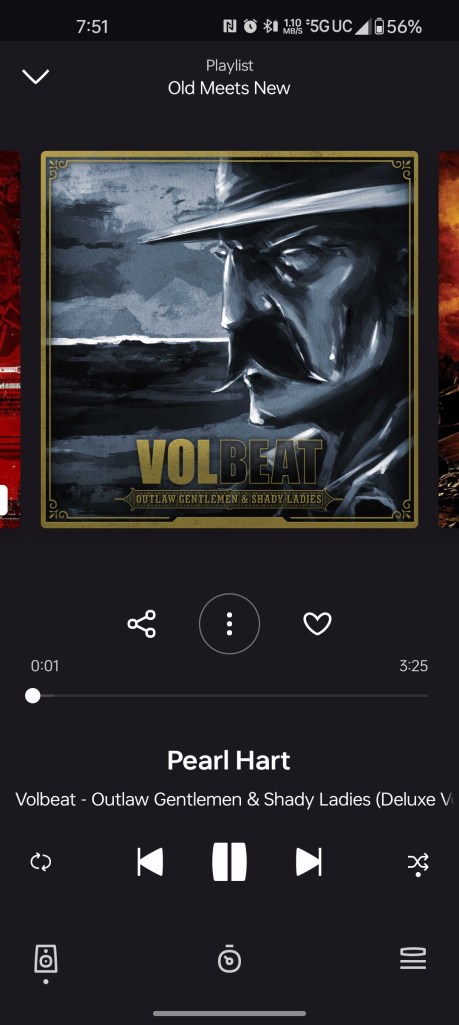
Perhaps I’ve been spoiled by TIDAL, as Deezer’s app and music offerings were both nice, but I feel myself missing TIDAL after the time I launched Deezer. Even though Deezer has both of the albums I complained were missing before on TIDAL, they were still missing some music, just far less.
However, after a few days of using Deezer at the workplace on Linux and on my phone with Android, I have been impressed with how rock-solid everything has been. Podcast support has been nice to have, as I would occasionally listen on my phone with the Spotify Android app before, although my podcast-listening days are generally behind me (circa 2015-18).
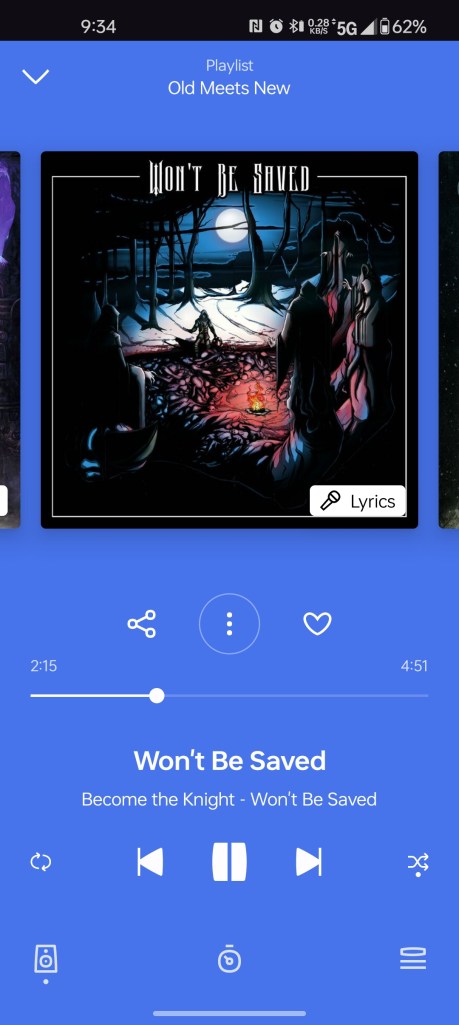
Still, out of the time I’ve used Deezer, I only have a couple of complaints with my experience. Even still, I can’t help but feel they’re a tad nitpicky.
For starters, I’m not really a fan of deals with the way Deezer handles lyrics. Each time I tried to display the lyrics, there was no effort on Deezer’s part to time and sync the lyrics with the music. Spotify does this, and TIDAL does too. Just to be sure this wasn’t because the song I was listening to was too obscure, I tried checking multiple songs, but every single time, clicking on “Lyrics” only displayed a static screen with the song lyrics. Why doesn’t Deezer scroll with the lyrics at all?
Still, Deezer does have a few odd tricks up its sleeve. I can’t seem to make it happen on the Android app, but the desktop app (which does support Linux unofficially) sports a neat feature to quiz over given playlists. You can start the quiz and listen to samples of given songs from the playlist while clicking which song title matches the sample song. Doing this faster nets you more points. After finishing your 10 questions, you are given choices to share your score or link others to the playlist to see if they can do better. While I’m not going to share a Deezer playlist with anybody anytime soon, I can’t help but think this is a novel feature. Considering how Spotify handles their Wrapped each year, making the music-listening itself a somewhat social aspect, I’m surprised Spotify hasn’t attempted this music-quizzing feature first.
Additionally, unlike TIDAL or Napster, Deezer is the only music service I’ve tried that attempts to match Spotify’s offerings to play podcasts. Granted, if you were expecting audiobooks, Deezer may be some ways off from attempting that just yet.
My last gripe with Deezer, if you can even call it that, is the most petty and minor one I can think of.
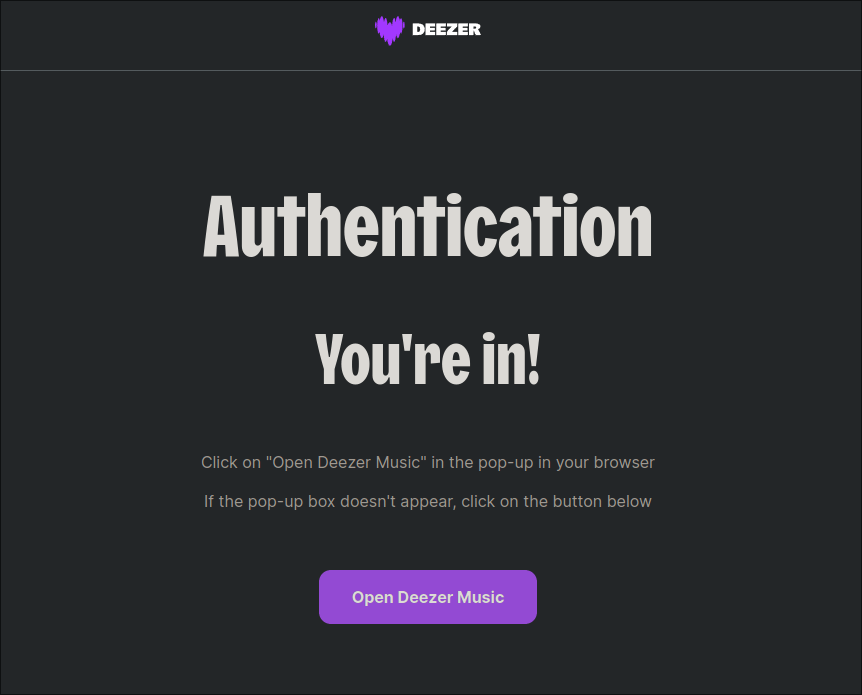
I really don’t like this header font. At all. There’s something I find off-putting about it that feels less professional than it should be. I know this has little bearing on the actual streaming quality and experience itself, but this is just something I personally don’t like. I can see most people not caring in the slightest about the font and carrying on, especially for those who would generally be worried about missing out on songs compared to Spotify’s offerings.
Final Verdict
I’ll try to keep this one short.
- Best Brand Recognition from 20+ Years Ago: Napster
- Best Looking UI: TIDAL
- Best Song Parity Overall: Deezer
- Best Additional Features: Deezer
- Best Quality of Life Improvements: TIDAL
- Best Choice for Podcasts and Music: Deezer
- Best Experience on Linux: Tie between TIDAL and Deezer
- Desperately Needs a CLI-App: TIDAL
- Most Likely Choice for Me to Stick With: TIDAL
While I initially started this entire challenge of sorts thinking I would abandon all three and just go back to Spotify, I may stick around for at least another few months to see how TIDAL keeps performing. I’ve been rather satisfied with the UI, usability, and Android app as well. Besides, maybe the albums I complained were missing will return eventually? (EDIT: Said albums are still missing from TIDAL over a year later.)
However, for most people looking for a Spotify alternative, I would have to say Deezer would likely satisfy most people’s use cases and needs, especially if podcast playback is a must. Personally, I’m still dandy with TIDAL, and I’m going to be sticking with it for at least a good while.
What About Self-Hosted Streaming?
Now I’m finally going to address the elephant in the room that is likely the question so many of you may have: Why go through all this trouble when you could just host the music yourself and stream it from your own media server?
It’s certainly a fair question to ask, especially after my tirade regarding streaming media availability, but there are a few things that do stop me from bothering with this otherwise viable solution:
- The hosting would cost money. I’m already hosting this blog as well as a separate Nextcloud server. I don’t want to pay for another server dedicated to music streaming that would likely cost more than any of these services separately per month.
- I listen to a lot of music. Hosting a server that would come anywhere near this amount of music would require a lot of hosting space. I don’t want to bother paying for that much storage.
- Let’s say that I can host my own server with my own hardware. Even if we have that situation, there would be a lot of extra work and overhead on my part just to make sure the services are working correctly. Most of the time, I feel like I got my Nextcloud server running with rubber bands and duct tape just to get it to a low-maintenance point; I don’t want to imagine the work I’d have to go through just to get a music streaming server set up in the same way. It bears repeating from a different post I’ve written, but I’m barely a sysadmin.
- Maintaining my (now aging) MP3 and FLAC collection used to require so much work on my part. I was the guy who needed everything tagged and organized properly, and I still shudder at the old times two decades ago when I’d download a low-fidelity song with zero tagging and a file name like
02_system_of_a_down_BYOB_.mp3, which made it so much harder to keep everything organized.
When Spotify first presented itself to me with its many conveniences, I found it intoxicating compared to all of the work I had to put into my existing music collection, so this is largely related to my overall aversion to hosting a music server; I would have to return to all of that extraneous work again, and I really don’t miss that. I get that DRM and all is usually seen as a bad thing, but in the case of music streaming, I see it the way Gabe Newell once said: “Piracy is almost always a service problem.” There’s a big reason I was more than happy to embrace Spotify despite the flat cost and convenience each month while I never wanted to touch iTunes with a 10-foot pole back in the 2000s.
Generally, music streaming doesn’t seem anywhere near as egregious as video or movie streaming in regards to missing content. I mean, sure, I did complain about a few albums not being available on TIDAL, but it’s nowhere near as irritating as wanting to watch the first movie in a series only to discover Netflix only has the second, fourth, and fifth installments because… licensing agreements? Then to watch the first one, you need to get Hulu and some annoying add-on that makes Hulu more expensive than it should be already, but you still won’t get to see the third movie because it’s all by itself on Max and Prime Video, or at least you thought it was on Prime Video because it’s only “available” to rent or buy, not for Prime users to stream for free…
Still, going back to music streaming as a whole, I am a rather pragmatic person, so readers in the future shouldn’t be surprised if I somehow change my tune on all of this by sometime next year and actually try hosting my own Jellyfin server (or whatever other server-side hosting software) to stream music. For now, however, I think I’ve made my point.
An Update Over a Year Later
This is a major update as of August 2025. I know it’s been quite some time, but just like I said in the above paragraph, I actually did it. I went ahead and started to not only self-host eventually, but I got myself an iPod as well. Despite that, however, if I really did need to stick with a streaming service, TIDAL was still quite good for my needs overall, although I have recently, at the time I add this update, canceled my subscription.
While I thought Spotify Wrapped was going to tempt me when the year ended, I signed back into my account just to check out my results between January and June 2024. However, Spotify Wrapped’s presentation was downright underwhelming compared to previous years. Subsequently, I had no issues staying with TIDAL a bit longer, especially considering the price was much more agreeable for myself.
I thought I might have been tempted at other points to ditch TIDAL in favor of Deezer’s more comprehensive selection of music. While I do miss a few albums here or there (the aforementioned ones I brought up are still totally MIA to this day), I was mostly fine with TIDAL’s offerings covering 95% of what I expect to listen to. However, with my recent switch to self-hosting and streaming, I will easily have more music I want to listen to than when I was using Spotify or Deezer.
Overall, I don’t see myself ever returning to Spotify. I was peachy keen with TIDAL for its sound fidelity and pricing, and I would still be using it if I wanted to stick to a paid streaming service at this point.
What About You?
What streaming service do you use, if any? Did this in-depth look make you consider trying a different one? Do you prefer a different one from the three I explored? Do you think my taste in music is utter garbage? (It’s fine if you do; my girlfriend seems to think so.) Feel free to leave a comment. I’d love to know what you think.
Further Reading
Dumping Spotify and Paid Music Streaming For My Offline Music Collection
 Sudo Science
25 responses to “I Tried 3 Spotify Alternatives within a Month. Here’s How They Compare.”
[…] expensive enough to warrant canceling unused or underused services and subscriptions. After having canceled Spotify in favor of TIDAL for now (Spotify is hiking prices as of late, after all), I decided to venture further with my […]
LikeLike
“Great breakdown of the streaming services! It’s interesting that you’re leaning toward TIDAL despite initially thinking you’d return to Spotify. TIDAL’s sound quality and usability are definite strengths, and while Deezer might have a broader appeal for those who want podcasts or a straightforward alternative, it’s awesome to see you giving TIDAL a chance.
As for the self-hosted option, you’ve nailed the big obstacles — cost and storage are certainly major considerations when you listen to as much music as you do. Still, for some, having full control over their library might be worth the extra effort. Personally, I think Deezer’s combination of music and podcast support makes it a well-rounded option for most users, and I’ve covered more about its features on if anyone’s curious.
LikeLiked by 1 person
With the layoff from Spotify of their “tastemakers”, it has become incredibly noticable any new music that is suggested to me has been paid off or just doesn’t tie-in to my listening interests. This article has been super helpful to me, especially from a Linux point-of-view. I am definitely going to give Tidal a try. Question for anyone reading however, does any service offer to import Spotify playlists and followed artists?
LikeLiked by 1 person
Glad the article was able to help! To be honest, I used TuneMyMusic (https://www.tunemymusic.com/) to transfer playlists from Spotify to all of the other services. The only drawback is if you will need to pay for at least one month of service if you have a giant selection of music, though I only felt I could justify it since I was trying three services at once.
I think only the first 2000 songs transferred are free? I don’t exactly remember at the moment, but there’s a reason I didn’t exactly give them a rounding endorsement in the post. I didn’t really like their business model.
LikeLike
Honestly, I’d rather pay straight up for using software that simply does its job well than deal with the typical sleaze of free apps. Behold their privacy policy. Could argue about the exact pricing, but they do need a business model to keep going, and building one earning honest money is imho better than selling personal info and siphoning life energy from their customers like so many other apps. 😛
LikeLiked by 1 person
Thanks for writing this up! I’m glad I found your article, it’s so much better than the shallow “top X” posts that tend to turn up in search results. ^_^
LikeLiked by 1 person
[…] With my media selected, I took the rest of my day to give a temporary goodbye to the streaming media I enjoy, such as my thousands of songs on TIDAL. […]
LikeLike
Hello, thank you for doing this little experiment and sharing it with fellow netizens. I was wondering if you were still feeling positively about your TIDAL experience after all these months? I’m waffling between signing up for that or Deezer since Spotify’s Discover feature and song suggestions have been completely gutted over the last year or so. Have TIDAL’s podcast options improved at all since you first wrote this?
LikeLiked by 1 person
Hello, and thank you for your comment! Since I first wrote this, I am still a TIDAL user and subscriber. I’m not much of a song discovery guy these days, mostly sticking with artists I like and related artists that sound enough like them.
Regardless, I did discover another advantage about TIDAL that might give it a slight edge over Deezer depending on the listener. If what I looked up is true, TIDAL pays the most to the artist than any other music streaming service, and Deezer pays even less than Spotify if my research is true. However, I found a conflicting report that claims TIDAL and Deezer pay comparable rates while Amazon streaming wins by a wide margin, although I think TIDAL might have the edge if you use its features to purchase merch from artists using the app. I wanted to corroborate this a bit more before updating the actual post on this information.
And as for TIDAL’s podcast options, I’m shocked to discover that I can’t actually find the podcast menu anymore! While they were really buried before, they are simply nowhere to be found now. I searched for a good 15 minutes on both the Linux and Android apps, but haven’t found so much as a hint that they ever existed. There’s a good chance that TIDAL simply looked at how meager the selection was and decided to remove the feature entirely.
LikeLike
Thank you, terrific work. I’m fed up with Spotify, especially the amount of content that requires Premium membership. I want to pay a flat rate and have access to everything orcatcleast most things. Am especially keen to hear who pays the artists the most when you are able to confirm but Tidal sounds great. Hoping 2025 has begun well for you.
LikeLike
[…] users worldwide have reported issues with their Spotify Premium APKs, leaving music lovers without access to their usual ad-free experience. Spotify Premium offers several perks, but […]
LikeLike
[…] But our other friend, the Irishman known as Guinn, however, surprised me entirely. Not only did he not forget I had this website, but he commented specifically on a few of my posts, including how I actually convinced him to switch away from Spotify to TIDAL a while back. […]
LikeLike
[…] 详情参考 […]
LikeLike
Thanks for the detailed comparison!
Another noteworthy effect of online music is the shortening of songs, since authors are only paid passed a small duration.
Anyway, leaving Spotify for two main reasons.
The first one is the PC app interface that gets worse and worse with every decision they make. No more like feature, despite an impressive number of complaints and subscribers to suggestions about reintegrating it, song authors less visible because of hindering video icons, no way to “blacklist” individual songs any more (bad for the “Discover weekly”), sluggish interface after a relatively small number of songs in a list (try browsing all the albums of most groups…), and so on.
The second reason is the terrible support. Spotify keeps sending me emails in another language, and despite asking them 1) to fix the issue once for all and 2) to please send me this last apparently contractual update in a language I can understand, neither was met. They keep second-guessing their customers’ language based on geolocation (not mentioning they also make mistakes by picking the wrong language for that location), and they refuse to resend those emails in another language.
What I really like with Spotify is the “Discover weekly” suggestions, but they’re on the decline, too. And songs are starting to disappear from my playlists (well, not disappear but get greyed-out).
LikeLiked by 1 person
[…] even with a separate DAC adapter like I was hoping it still would. My only real option to listen to my TIDAL music library while driving now would be to shill out for an expensive stereo system upgrade, likely one with a […]
LikeLike
I can not get Sptfly to open. it says i have the files on my computer.
LikeLike
[…] hinted at the possibility a good while back, but I’ve been rethinking how I enjoy my music over the past few months, and that’s also […]
LikeLike
I have been looking for a Spotify alternative for some time now, mainly for ethical reasons. However, every review of alternatives I have found so far was insanely unsatisfying and disregarded aspects that are vital to me. I didn’t want to do all the work of switiching to another app, only to later realize it has aspects I dislike or lacks functions I find integral to a good music app. (Yes, I am very particular about some things, especially when it comes to design and certain functions). So thank you from the bottom of my heart for this detailed post. You covered all aspects I find vital in music apps and I will now make the switch to TIDAL. Your accuracy and method were greatly appreciated.
LikeLike
[…] aware that I haven’t used Spotify in ages now, and I didn’t have any subscriptions to Netflix or the other video streaming services to […]
LikeLike
[…] While I could be wrong, I largely credit Netflix for popularizing the now-ubiquitous subscription model we see today. It’s thanks to them that we can subscribe to not just watch TV and movies, but to listen to music or use software. There’s an entire litany of services such as HBO Max, Hulu, Disney+, and more. For music, you can check out Spotify or several other options if you don’t like it. […]
LikeLike
Hi, does anyone know if there’s a Spotify alternative that also has the Band ‘Radio’ Feature? I use that the post to play stuff similar to what I like, and discovering new stuff. Thanks.
LikeLike
A bit late to the party (as is normal for me lol) but thanks for the detailed info regarding other music streaming apps. I’ve just this minutes cancelled my Spotify premium as getting fed up with the price hikes… not to mention they keep sending me ‘music you may like’ messages showing Taylor Swift, Beyonce etc…How they’re getting those ‘connections’ from all my already downloaded albums is beyond me.. My Spotify library consisted of the Alter Bridge entire catalogue and 90% of Volbeat’s, with a few nods to Dream Theater and The Cranberries…so no Spotify, this garbage your suggesting to me is not music ‘I may like’… Jumped onto Google to ask if there are music streaming services other than the obvious ones and spotted your blog.. believe it or not, I wasn’t aware of Tidal, so thanks for the detailed run down. Sounds like I may give them a trial run as I can’t live without my music but getting so hacked off with Spotify… PS Tell your girlfriend your music taste is not cr*p, I noticed the Volbeat album cover as I was scrolling 😉
LikeLiked by 1 person
Thanks for your extensive reviews of the apps. I am however missing, from a purely selfish POV ;), integration with Sonos smart speakers.
Spotify lets you control the Sonos speakers directly from the Spotify app as well as from the Sonos app.
Deezer does not. You have to link the Deezer app in the Sonos app then run it from there with limited functions.
I have’t tried Tidal yet – the reviews on the Android app store are not exactly inspiring (avg review 3.1)…
We have 6 Sonos speakers dotted around our house, so this function is very important for us.
LikeLike
So much to digest here! Thanks!!! Have bookmarked and will return early in the New Year to digest and properly make some plans about sorting my music. I curate a LOT and don’t wanna lose my lists if I migrate!! Currently trying QoBuz until end January so clocks-a-tickin’
LikeLike
If you try different Spotify alternatives, MusConv can help you move your playlists between services easily so you don’t lose your music
LikeLike