

I finished my memo book from a somewhat recent blog post a while back. To summarize that post, I was unsure how to get the best use out of a pocket-sized notebook to compliment my bullet journal until I saw a YouTuber who gave me an amazing idea on how to do so.
Two weeks later, I completed the memo book. 60 pages of useful information, idle thoughts, and fleeting ideas now fill the A6-sized notebook. I also learned as I wrote my way through it that worrying about perfection doesn’t seem like it’s worth stressing over. In fact, the mish-mash of different inks and pencils, the mistakes, the corrective tape, and many of the pages I tried repurposing and reusing in creative ways seems to give the notebook, with its now weathered and worn cover, a bit of character and personality it wouldn’t have had otherwise.
But something I realized during my time writing with my notebooks was how often I wrote some of the same words regularly. It seemed like such a waste of energy, time, and ink or graphite to spend so much time writing a few of them over and over.
Then it hit me: Why not create or use some symbols as a sort of notation to substitute commonly-used words?
By doing so, I would not only save time, but I could find a way to make the bullet journal-associated practice of rapid logging more rapid.
What Words Do I Write Most?

This was an essential question to ask myself if this was ever going to be a useful idea. By asking and evaluating what common words I usually write, I was able to successfully come up with substitutions I can easily use in my notebooks. My favorites in particular moved from just the memo books and made their way to my full-sized bullet journal as well. Some have been refined over time (a few of the ones I came up with felt cumbersome to write when I tried them out), but others were perfect from the get-go.
“Eventually, I started to notice more words I wrote longhand regularly and started to think of more symbols to replace them, and the cycle simply continued.”
It took me a while, and I’m still developing it, but I already amassed several words I substitute with symbols.
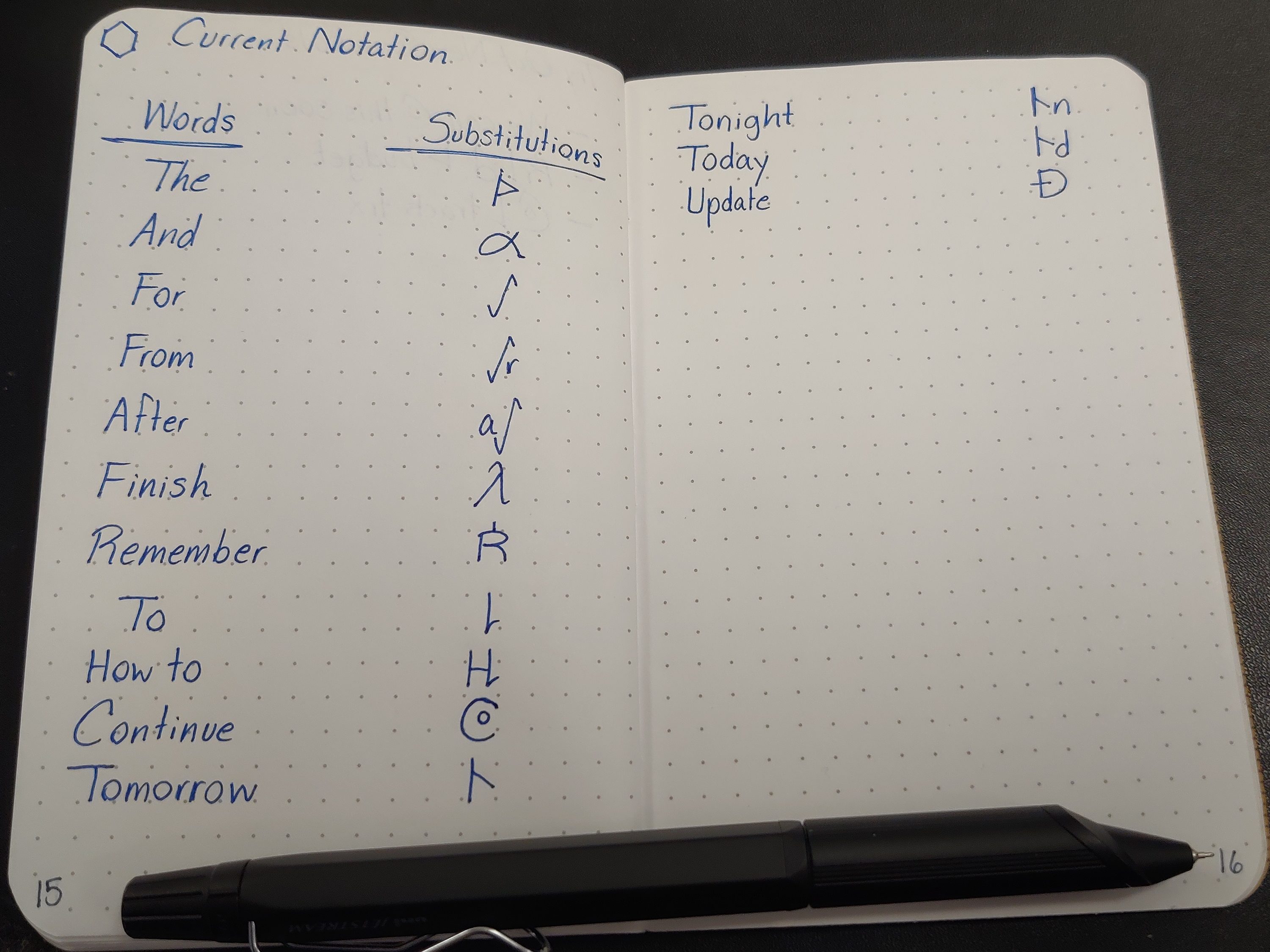
How Do You Remember All Those?
Keep in mind that this is something I did over time. One week, I decided I wanted to substitute a few words (think two or three at a time), and then I started to experiment with how the symbols I picked out felt in actual writing. I would change a few that didn’t look quite right, were too hard to tie to the original character, or just felt so clunky to pen down that the original word would have sufficed.
When I felt I had perfected everything, I continued to use them. Eventually, I started to notice more words I wrote longhand regularly and started to think of more symbols to replace them, and the cycle simply continued.
This gradual approach helped by allowing me the time to practice writing and recognizing a few symbols at a time in smaller bursts. I knew I didn’t need to sit down and write a giant list of symbols in one sitting just to forget what most of them stood for a day or two later.
The Logic Behind My Symbols
The
For this one, I was reminded of the Old English letter “thorn,” which looks like this: þ. The letter originally represented a phonetic “th” sound, though it was eventually dropped during the Middle Ages after being substituted for years with the character “y.” This also explains why signs that say “Ye Old Store” or whatever would be pronounced “The Old Store.”
There is some attempt to try and bring the letter back into vogue in English, but for my purposes, I wanted to use the character on its own to substitute the entire word “the.” However, when I started writing it by hand, I felt it was too easy to confuse with a lowercase p or b. I took it upon myself to make the rounded part more pointed so it stands out more and is less likely to be confused with anything else.
I know the word “the” is already short as it is, but considering how often I write it, this little trick saved me a lot more time and effort than one could guess.
And
I struggled with this one, especially since I didn’t want to just bring back ampersand (&) and call it a day. I don’t normally have issues writing an ampersand in the first place, but writing it still doesn’t feel as smoothly as it otherwise could’ve. While others have “solved” the ampersand by simply writing a small “3” with tiny, vertical lines above and below it, I wanted something a little more elegant.
Then I recalled how a lowercase alpha looks: α. It’s not too difficult to write, but at the same time, it feels easier to draw than an ampersand, especially since I can do it in one smooth, simple loop.
For, From and After
I must confess that this is the first notation symbol I ever started writing a few years ago, but the only thing is I never bothered to venture further until just recently. These all stemmed from the same symbol, which was originally a “fancy”-looking lowercase “ƒ,” which I occasionally would write to start the word “for” in the first place, but without the horizontal line crossing through it. It’s also tilted a bit more clockwise so it stands out a bit more.
To make things easier for myself, I adapted the symbol with an r afterward to signify “from,” and an a before it to signify “after.”
Finish
I couldn’t just use another character that looked like the letter “f” when I was already using one to signify “for,” so I had to get a bit more creative with this one, and somehow, writing the above symbol with an “i” afterward didn’t quite cut it for me. I wanted something else that stood out, especially for tasks I did want to complete.
Then I recalled how I never finished learning lambda calculus when attempting to learn how to program in Haskell. I decided that the lowercase lambda (“λ”) would be a perfect reminder of how I should (have) finish(ed) learning about that.
Remember
I wanted something easier that simply writing “Re,” especially since I already use “re:” to signify “in regards to,” just like I learned when I first started to bullet journal.
I decided to experiment with the uppercase R, and I decided to add a little vertical line at the top of it. The idea that makes me always remember it is how I ask myself if I remember what that little symbol above the “R” means.
To and How To
To be fair, the word “to” is already rather quick and easy to write by hand. However, I thought it could’ve been slightly easier. That’s when I opted to write the lowercase letter “t” with the little “tail” on it, for lack of a better word.
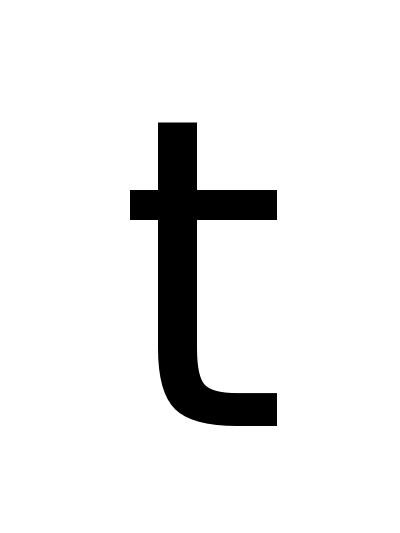
Then, just like when I came up with my symbol to substitute “for,” I removed the horizontal line going through it. Just to make it pop a bit more, I made the so-called tail’s angle a bit sharper and more distinct.
At some point, I also decided to shorten “how to” to the uppercase “H” with the sharpened tail in a stroke of spontaneity.
Continue
After noticing how often I wrote to continue tasks recently, I took it upon myself to discern a way to shorten this word next. I soon came up with the relatively elegant solution of tucking a lowercase “o” inside of an uppercase “C.” It’s much easier to write than the entire word, so this one has already saved me a significant amount of time.
Tomorrow, Tonight, and Today
I started to study Japanese this past month, and I noticed the Katakana character “ト” makes the sound “to.” It’s easy to not mix it up with anything else, and just like I did with the symbol for “for,” I could add other letters to adapt other words. I now save a ton of time with two strokes of my pen writing a “ト” instead of nine to write out the entire word “tomorrow.”
This was an especially useful character because adding an extra letter lets me abridge “today,” and “tonight” as well.
Update
This was the most recent one I came up with, but it was also the hardest to come up with something that would suit my needs. In fact, there’s a slight chance at this time that I might change it to something else if I’m still not satisfied with it.
I decided to go with the Ð, a character I’ve seen but I’m not too familiar with. To remember it at this time, I ask myself why I updated the letter “D” with a line through the side of it.
Why Didn’t You Use ABC for XYZ?
This is a very personal system I created for myself out of a bit of gradual experimentation over time. For instance, I could easily understand why somebody would ask why I didn’t just use “ト” in place of “to” instead of a fully-invented symbol since they both make the same sound (roughly) anyway.
In short, the whole thing is still developing and not set in stone. While I’m more than okay with others taking my existing symbols and trying them out for a bit, I know that there’s no objective best way to do this. By all means, I readily invite others to not only try the symbols, but make their own updates and introduce new symbols entirely. Just like the bullet journal, this system of symbols is fully flexible.
That Was Convenient!

I’ve been using some of these symbols longer than others, but so far, everything’s been working great. It’s amazing to write something akin to “Remember to continue the update tomorrow” in just a handful of symbols instead of writing a single longhand word at a time to string together a sentence.
“This gradual approach helped by allowing me the time to practice writing and recognizing a few symbols at a time in smaller bursts.”
Since drafting this post, I’ve also come up with more symbols and updates since then. I already tweaked and started experimenting with a simpler symbol than what I’m using for “Continue,” (let’s see how it works out) and I came up with ways to drastically shorten “was,” “may,” and “my” just recently.
Protip: Explore Other Alphabets
As some may have noticed, a handful of the symbols I’ve chosen already exist in some form elsewhere while another few were entirely made up by myself just for the purposes of this idea. Instead of having to make up entirely new symbols from scratch, I would recommend exploring other non-Latin alphabets for inspiration. As mentioned, I used a Greek “α” for “and,” and I used the the Japanese “ト” for “tomorrow,” and there are plenty of other examples out there that already exist. No need to reinvent the wheel!
“Just like the bullet journal, this system of symbols is fully flexible.”
I just discovered how the Cyrillic alphabet looks when written in cursive and I think I might want to see if any of the symbols could substitute commonly-used words for myself as well. Once I see what else works and what I could change, I’ll likely post a Ð on this entry. 😉
A big takeaway I have for anyone else who writes by hand as often as I do is to think about what words you write the most frequently. Is there a way you could shorten those words to save yourself valuable time?
What words do you write down the most? How much time and energy could you save yourself by shortening them in some way?
 Sudo Science